









How to use a commercial slush machine
Unlike many frozen beverages that rely on simple blending, slush preparation in a professional setting demands precision. Understanding how to use a slush machine means managing not just the recipe, but also timing, temperature, and equipment handling. For operators, mastering your commercial slush machine is the difference between delivering a perfect, consistent product or dealing with frustrating inconsistencies that disrupt service and increase waste.
Beyond flavour, what makes slush unique is its complex physical balance. Ice crystals, syrup concentration, temperature regulation, and mechanical agitation all play a role. For businesses, controlling these factors is not only key to customer satisfaction, but directly impacts profitability, product waste, and energy consumption.
Understanding how a slush machine works
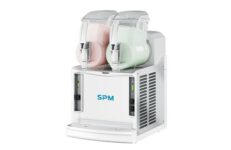
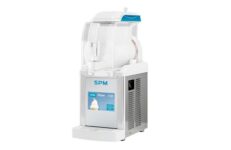
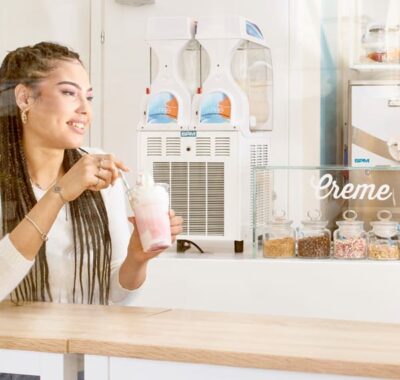
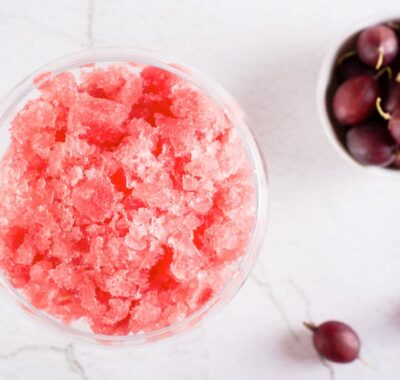
At its core, a slushie machine freezes a liquid mixture into a semi-frozen, drinkable consistency. The machine continuously agitates the mix as it freezes to prevent large ice crystals from forming. The result is a smooth, uniform slush with suspended micro-crystals that provide the desired texture.
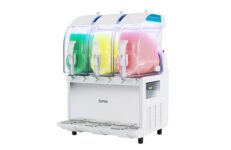
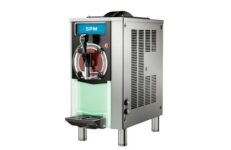
Modern commercial models like SPM’s I-PRO 2 E allow operators to run in both manual and fully automated modes, depending on business needs.
- In manual mode, the operator controls each function, including spiral activation, freezing, and chilling cycles, directly from the capacitive touchscreen.
- In automatic mode, the machine can be pre-programmed to start and stop at specific times throughout the week, reducing manual intervention and optimising energy use during service hours.
The programmable daily and weekly scheduling feature simplifies operations during high-volume service, allowing slush to be ready exactly when needed, even in variable ambient temperatures. This automation also helps businesses minimise staffing needs during preparation times, particularly useful in multi-location chains or high-turnover venues.
Setting up your commercial slush machine
Proper assembly and setup are crucial for safe, efficient operation.
Assembly
- Insert the red gasket followed by the suction gasket (lightly lubricated with food-grade vaseline).
- Fit the spiral inside the tank and secure it with the fixing knob.
- Apply a thin layer of vaseline to the lower part of the tank before positioning and locking it.
- Lubricate the o-rings on the dispensing tap and install it.
- Complete assembly by attaching the under-lid, locking key, and drip tray.
Initial filling
- Prepare the beverage base according to manufacturer recommendations, ensuring correct sugar content for optimal freezing.
- Pour the mixture into the tank up to the indicated maximum fill line.
Power and start-up
- Connect the machine to a dedicated power source.
- Use the touchscreen interface (or mechanical switches for non-electronic models) to start the freezing and mixing cycles.
Following these steps ensures proper assembly, consistent freezing performance, and minimises start-up delays.
Always refer to the official SPM user manuals for detailed instructions and safety guidelines. In case of doubts or specific operational questions, contact SPM’s technical support team.
How to make slush with a slushie machine
Once the machine is set up and running:
- Activate the freeze mode to initiate the chilling and agitation cycle.
- Monitor the freezing progress via the transparent insulated bowls; most commercial machines will achieve the desired consistency within 45 to 90 minutes, depending on ambient conditions.
- The product is ready when it reaches a thick yet pourable texture.
During service, operators can easily dispense portions directly into cups by pulling the tap lever. The product density can also be adjusted using the consistency control knob located at the rear of the machine—turning clockwise for a softer product and counterclockwise for a firmer texture.
Tips for optimising production speed
- Pre-chill your mix: Adding cold liquid reduces freeze time significantly.
- Monitor the product’s Brix level (sugar concentration), as correct values are essential for proper freezing performance. Avoid bases with excessive water content, which may over-freeze and put strain on the machine.
- Strategic machine placement: Avoid locations exposed to direct sunlight or close to hot kitchen equipment. Ensure there is sufficient free space around the unit to allow proper air circulation and efficient heat exchange.
- Use insulated tanks: SPM’s I-Tank™ technology helps stabilise internal temperatures, even in hot environments, reducing energy costs and improving freeze times.
- Prepare for peaks: Automated scheduling ensures machines are ready when demand surges.
Cleaning and maintenance: the key to long-term performance
When service is over, proper cleaning and sanitisation are vital.
- Deactivate freezing but leave the agitator running for several minutes to soften remaining product.
- Empty the tank completely, disassemble components, and wash with warm water and gentle soap.
- Perform thorough sanitisation following detergent manufacturer guidelines before reassembly.
Neglecting daily maintenance can not only impact taste and hygiene but also compromise freezing efficiency and increase mechanical wear over time. With correct daily care, SPM slush machines maintain long-term reliability, energy efficiency, and consistently high product quality—helping your business meet both operational standards and customer expectations shift after shift. As a simple best practice, always allow all components to dry thoroughly before storing them, to avoid moisture retention and ensure longer lifespan of the parts.
Want to know more about
our products?
For any support or information, do not hesitate to contact us!